
Women's Health and Autoimmune Disease
A blog post for National Women's Health and Fitness Day
National Women's Health and Fitness Day is a chance to celebrate strength, movement and self-care. It is also a good moment to talk about a health reality that too many women live with quietly: autoimmune disease.
A pattern that is hard to ignore
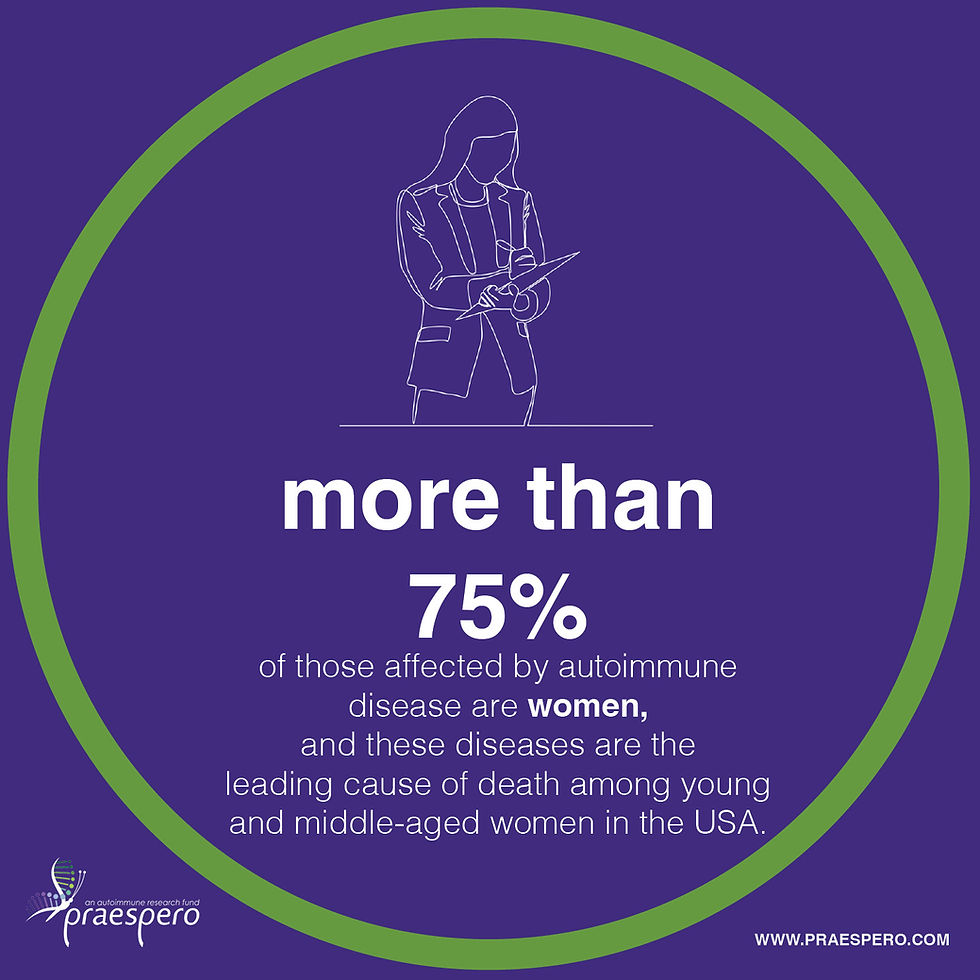
More than 75% of people affected by autoimmune disease are women, and some conditions, such as lupus and Sjögren's syndrome, affect women at a ratio as high as nine to one [1]. Shockingly, according to one study, these conditions are a leading cause of death among young and middle-aged women in the United States [2].
Autoimmune disease occurs when the immune system loses its ability to tell the difference between foreign invaders and the body's own healthy tissue. Once you see how heavily it falls on women, an obvious question follows: why?
What might explain the imbalance
Researchers do not have a complete answer yet, but three factors stand out.
🧬 Hormones. Shifts in sex hormones, particularly estrogen, progesterone and prolactin, can strongly influence immune cell activity [3].
🧬 Genetics. Females carry two X chromosomes, which hold a high concentration of immune-related genes. This can raise vulnerability when X-inactivation goes awry [4].
🧬 Environmental triggers. Infections, chemicals, stress and toxins can interact with genetic predisposition and set off an overactive immune response [1].
Understanding these differences matters. Every clue about why women are affected more often is also a clue about the root causes of autoimmune disease for everyone.
The long road to an answer
For many women, the hardest part is not living with symptoms but getting a name for them. The average person with a serious and common autoimmune disease waits 4.5 years for a diagnosis, and sees between four and five doctors along the way [5].
Part of the problem is structural. Both the Canadian and U.S. healthcare systems tend to be organized in silos, often around individual body parts. Autoimmune diseases do not respect those boundaries. They move across joints, skin, thyroid, gut and more. A patient may describe joint pain to one specialist and digestive trouble to another, and no one ever sees the full picture.
Gender bias can add to the delay. Women's chronic pain is sometimes attributed to stress, anxiety or hormonal changes, which can leave real symptoms unexamined [6].

Practical steps women can take
Until the system catches up, experts suggest a few ways to advocate for yourself [6,7,8]:
👉 Map your family history. Autoimmune tendencies often run in families, so note thyroid issues, severe arthritis or chronic skin conditions among parents, aunts and grandparents.
👉 Keep a specific symptom journal. "I feel tired and achy" is hard to act on. "Four days a week, my morning finger stiffness lasts 45 minutes, and I'm ready for bed by 7 p.m." gives your doctor something concrete.
👉 Ask about the right specialist. If your general practitioner is uncertain, ask for a direct referral to a specialist who handles your primary symptom. See a rheumatologist for joint pain/inflammation, a gastroenterologist for digestive tracking, or an endocrinologist for metabolic/thyroid fluctuations.
👉 Ask about baseline screening. If you suspect underlying issues, ask your provider to run an initial screening panel. This typically includes an Antinuclear Antibody (ANA) test (a primary autoimmune marker), a Complete Blood Count (CBC), and general inflammation trackers like CRP (C-Reactive Protein) or ESR.
👉 Seek a second opinion. If your symptoms are dismissed as being "in your head," do not stop there.
Everyday habits also support immune health.
👉 Track High-Risk Hormonal Windows: Major hormonal shifts (such as pregnancy, postpartum, perimenopause, and menopause) are prime triggers for underlying autoimmunity to flare up. Work with a physician to actively monitor your health during these life phases.
👉Adopt an Anti-Inflammatory Eating Regimen: Focus heavily on fresh vegetables, lean proteins, omega-3 fatty acids, and fermented foods while systematically limiting processed carbohydrates, refined sugars, and inflammatory triggers.
👉Manage Stress with Executive Priority: Women tend to carry disproportionate emotional and caregiving burdens resulting in chronic mental stress. This triggers biological immune dysfunction and spikes inflammation. Intentionally schedule nervous system downtime daily through mediation, deep breathwork, walking or systems that you know to help alleviate stress in your life.
👉Optimize Vitamin D and Sleep: Ask your doctor to check your vitamin D levels, as clinical deficiencies are closely tied to active autoimmune progression, especially in lupus. [9] Prioritize 7 to 9 hours of quality sleep to give your tissues vital recovery time.
👉Audit and Reduce Environmental Toxins: Minimize your daily toxic load by swapping out known endocrine-disrupting chemicals. Opt for cleaner household cleaners, limit plastics, and avoid artificial fragrances to ease the strain on your immune system.
None of these replaces medical care, but they are meaningful ways to look after yourself.
Why visibility matters
Autoimmune diseases are usually known by their individual names, such as lupus, rheumatoid arthritis, multiple sclerosis or Crohn's disease, rather than as a group. That makes it easy to overlook how common they are and how many women they touch. Low visibility means lower urgency, and lower urgency means less attention, less funding and slower progress.
This is where Praespero comes in. The name is Latin for "to nourish hope," and that is the spirit behind our work. We fund bold, unconventional research that seeks the root causes of autoimmune disease. We bring immunologists, physicians and engineers together through our Praespero Summits to share knowledge across disciplines. We also believe in partnering with the immune system rather than only suppressing it. Since 2018, we have supported more than 30 labs around the world.
Breaking down silos is central to that mission. Autoimmune disease is interconnected, so the science and the care that address it must be too.
Join us
This National Women's Health and Fitness Day, we invite you to help raise the profile of a disease that happens in women far more than men.
But in reality, when you consider the economic consequences of invisible illnesses - absenteeism, presenteeism, parentification, etc. - autoimmune diseases effects everyone.
✨ Share this post with the women in your life.
✨ Start a conversation about autoimmune disease with your family, friends and colleagues.
✨ Support research that dares to look deeper by donating at Praespero.org.
Together, we can accelerate the science to end autoimmune disease.
References
Calabrò A, Accardi G, Aiello A, Zarcone R, Candore G. Autoimmune diseases are more common in women: insights into sex and gender differences in autoimmunity. Explor Immunol. 2026;6:1003241. doi:10.37349/ei.2026.1003241
Walsh SJ, Rau LM. Autoimmune diseases: a leading cause of death among young and middle-aged women in the United States. Am J Public Health. 2000;90(9):1463–6.
Desai MK, Brinton RD. Autoimmune disease in women: endocrine transition and risk across the lifespan. Front Endocrinol (Lausanne). 2019;10:265. doi:10.3389/fendo.2019.00265
Goldman B. Autoimmunity's XX factor [Internet]. Stanford Medicine Magazine. 2024 Apr 29 [cited 2026 Sep 23]. Available from: https://stanmed.stanford.edu/why-women-more-autoimmune-disorders/
Benaroya Research Institute. Diagnosing autoimmune diseases [Internet]. [cited 2026 Sep 23]. Available from: https://www.benaroyaresearch.org/blog/diagnosing-autoimmune-diseases
Office on Women's Health, U.S. Department of Health and Human Services. Autoimmune diseases [Internet]. [cited 2026 Sep 23]. Available from: https://womenshealth.gov/a-z-topics/autoimmune-diseases
Autoimmune Association. Tips for getting a diagnosis of an autoimmune disease [Internet]. [cited 2026 Sep 23]. Available from: https://autoimmune.org/resource-center/diagnosis-tips/
Mayo Clinic Connect. Tips for getting a proper diagnosis of an autoimmune disease [Internet]. [cited 2026 Sep 23]. Available from: https://connect.mayoclinic.org/discussion/tips-for-getting-a-proper-diagnosis-of-an-autoimmune-disease/
Ritterhouse LL, Crowe SR, Niewold TB, et alVitamin D deficiency is associated with an increased autoimmune response in healthy individuals and in patients with systemic lupus erythematosusAnnals of the Rheumatic Diseases 2011;70:1569-1574.



Comments