
Prevention, Precision, and Purpose: Praespero at BIO International 2025
- Praespero
- 1 hour ago
- 3 min read
Some members of our team recently had the privilege of representing Praespero at the BIO International Convention in San Diego - and it was everything we hoped for, and then some.
With over 20,000 life sciences and biotech professionals and more than 1,100 speakers from 76 countries, BIO is a vivid reminder of how much talent, passion, and potential is being channelled into the future of human health. For Praespero, it was an opportunity to engage, learn, and advance conversations that matter deeply to our mission.
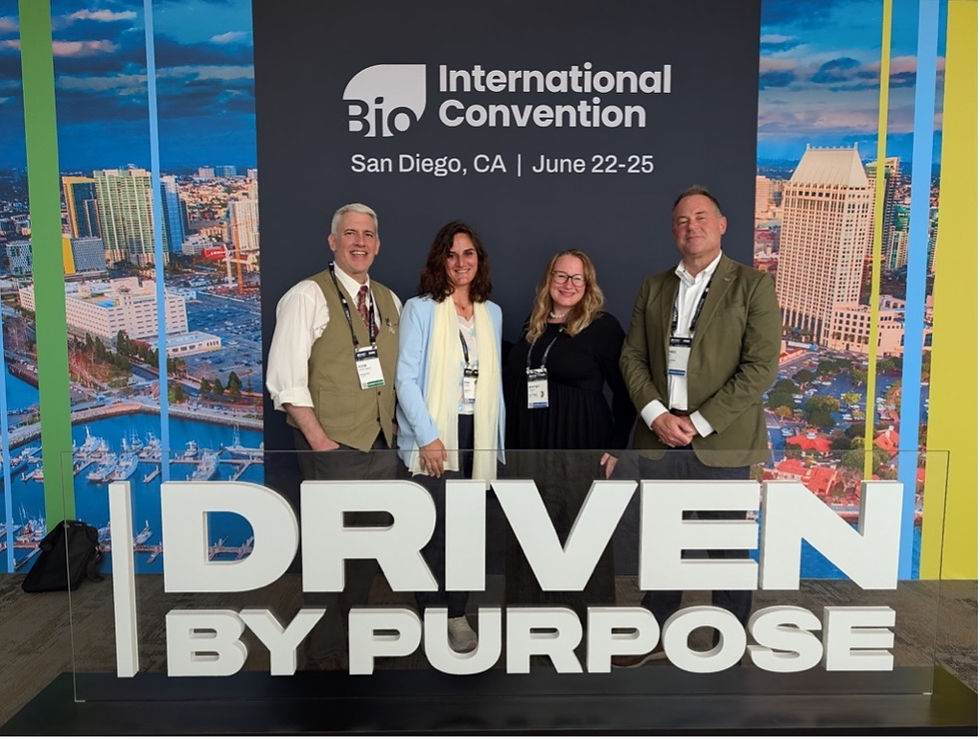
Pictured are Scientific Advisory Board members Dr. Rana Herro and Dr. Adam Buntzman, Board Director Whitney Dueck, and our Development Consultant, Christopher Lee. Each brought something unique to the week, and together, they came home with hearts and minds brimming with possibility and hope for the future of autoimmune disease research.
Dr. Herro thrived in her natural habitat. With multilingual capabilities spanning Arabic, French, and beyond, she dove into conversations with researchers and innovators from around the world, including some genuinely exciting insights on healthcare innovation coming out of the UAE.
Dr. Buntzman hit the ground running and built over 40 meaningful connections across the week. A real highlight was a Fireside Chat with Her Excellency Dr. Noura Al Ghaithi, Undersecretary of the Department of Health in Abu Dhabi, who presented twice at the conference. Dr. Al Ghaithi spoke about something that resonated deeply with our whole team: the UAE's commitment to the Proactive Precision Healthcare model.

Their model is grounded in a compelling idea - that healthcare systems have every reason to invest in keeping its citizens well before they ever get sick.
Rather than waiting for illness to arrive and responding with treatment, the UAE is actively incentivizing healthy living: rewarding citizens for physical activity, better nutrition, and the daily habits that reduce the burden of disease over time.
This puts the country at the forefront of life sciences innovation, accelerating high-impact clinical studies and leveraging the Emirati data initiative, as well as AI to advance precision medicine and early detection for better patient outcomes.
It's a long game, and they're playing it with intention - shifting from a system that reacts to illness to one that anticipates it, from standardized care to care that is genuinely tailored to each individual. Outcomes improving not by chance, but by design.
This speaks directly to what Praespero believes. We support research that works upstream, asking not just "how do we treat this?" but "what is actually causing this?" We're committed to moving beyond immunosuppressive approaches toward solutions that are more sustainable, more targeted, and — yes, we'll dare to say it — potentially curative ones that work with the immune system, not against it.
We're also inspired by the growing possibility of "N=1" medicine: the idea that advances in AI and biological data are bringing us closer to a world where treatment isn't designed for a disease category, but for a single person.
Your biology. Your history. Your solution.
Christopher Lee found the gathering to be an exciting place of vast opportunity for developing solutions for people suffering from disease. "I was pleased to bring attention to several breakthrough possibilities in the autoimmune space and discussing opportunities with potential partners," he said.
Whitney Dueck spent much of her time immersed in the AI in biotech and bioscience sessions, which she thought to be one of the most energizing themes of the entire conference. A few things she brought back:
AI is becoming the infrastructure of biotech, not just a tool. Companies like NVIDIA now have dedicated Vice Presidents of Healthcare. It's a signal of just how central software has become to the future of medicine and drug development.
The development pipeline is getting faster. AI is helping design novel molecules, predict biological outcomes, and dramatically compress timelines that once stretched a decade or more. The vision of moving from discovery to patient in a fraction of that time is becoming less science fiction by the day.
But human partnership remains irreplaceable. "The most consistent message across every AI panel: the technology is powerful, but the biological, ethical, and human dimensions of medicine still need us in the room," said Whitney. "The most exciting future isn't AI replacing researchers. It's AI empowering them to do what wasn't previously possible."
Praespero looks forward to building on the connections and conversations that came out of BIO, and continuing to show up for these important global exchanges for years to come.
We're inspired by the growing possibility of "N=1" medicine: the idea that advances in AI and biological data are bringing us closer to a world where treatment isn't designed for a disease category, but for a single person.


Comments